A New Treatment for Articulation Therapy: Visual Biofeedback
At Open Lines, our team specializes in treating speech sound differences, delays, and disorders and we are deeply committed to applying cutting-edge, evidence-based practices into our work. That’s why we’re excited to integrate visual biofeedback into our comprehensive, holistic treatment programs for speech sound production. By combining the latest research with our client-centered PRESENCE™ approach, we seek to offer the most effective, personalized support to help patients meet their goals as quickly as possible.
What is Visual Biofeedback?
Visual biofeedback provides real-time representations of speech elements—such as tongue and palate movements—that are typically difficult to perceive (McAllister, n.d.). By making these articulatory patterns visible, it helps individuals in articulation therapy produce their target sounds with greater accuracy and ease.
Understanding Speech Sound Production
Speech sound production consists of a series of complex movements of tongue, lips, and teeth to produce a target sound (e.g., /r/).
It is developmentally appropriate for young children to exhibit speech sound substitutions, omissions, or distortions, such as replacing /r/ with /w/ (e.g., “wing” for ring). However, if these errors persist past the expected age of elimination, a child may have a speech sound delay or disorder and it is recommended to seek an articulation evaluation with a licensed speech-language pathologist.
In some cases, individuals without a speech disorder may seek articulation services to address speech differences for various reasons, including enhancing control of the motor speech system when learning or using a second language.
Outlining the Types of Biofeedback and How They Work
There are numerous types of visual biofeedback being researched and implemented in clinical settings for articulation. Two common types of biofeedback being used for articulation therapy are ultrasound biofeedback and visual-acoustic biofeedback.
Ultrasound biofeedback uses a small probe placed under the chin to provide real-time imaging of tongue movements. The tongue is considered to be the most important articulator for speech production.
Research has explored the use of ultrasound biofeedback for children with speech sound disorders, including childhood apraxia of speech (CAS). Multiple studies show that ultrasound biofeedback can have a meaningful impact for children working on producing /r/ sounds (Spencer et al., 2023). It is also indicated for children who struggle with /k/ and /g/, as well as for those with CAS targeting /r/ and /s/ sounds (Heng et al., 2016; Preston et al., 2017).
Researchers at The University of Cincinnati have created a fun, child-friendly ultrasound biofeedback game for children to practice /r/. Currently, The University of Cincinnati Hearing and Speech Clinic holds a 2-week summer camp that uses ultrasound biofeedback to target /r/ for children between the ages of 7 and 17 years.

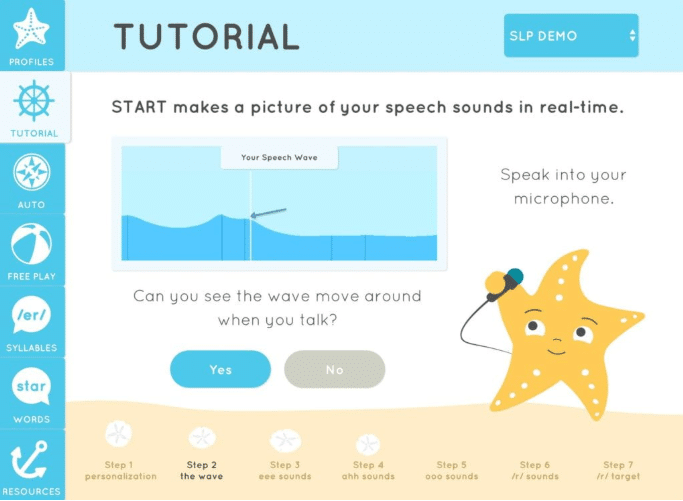
Visual-acoustic biofeedback (VAB) creates a computer-generated picture display of target speech sounds. As individuals speak into a microphone, the system produces a visual output—similar to a spectrogram—on a computer or tablet, offering a clear representation of tongue, mouth, and throat movements during speech production.
Studies completed by researchers at Montclair State University, Syracuse University, and New York University suggest the use of VAB is useful for children with speech sound disorders who are working on /r/ (Hitchcock et al., 2023). They also state VAB could be useful for multiple populations in addition to those with speech sound disorders, including people with hearing loss and individuals learning a second language (Hitchcock et al., 2023).
At New York University, Dr. Tara McAllister has created staRt, an evidence-based, easily-accessible VAB application for practicing /r/. This application is for iPad and web-based use and can be found on the iOS app store or online.
Next Steps
If you are pursuing or are currently receiving articulation therapy and you think visual biofeedback is the right fit for you, speak with a licensed speech-language pathologist, who can provide individualized, evidence-based recommendations.
If you would like to read more about visual biofeedback, you can visit the below links to learn about the research being conducted and available treatment options:
- https://www.nyu.edu/about/news-publications/news/2025/september/-children-receiving-biofeedback-speech-therapy-improved-faster-t.html
- https://steinhardt.nyu.edu/priism/speech-therapy-and-biofeedback
- https://cahs.uc.edu/about/departments-schools/communication-sciences-and-disorders/speech-and-hearing-clinic/ultrasound-visual-biofeedback-for-r.html
At Open Lines, our Pediatric Articulation Program supports children who experience difficulty producing clear, intelligible speech due to articulation delays or disorders. Our specially trained licensed Speech-language pathologists begin with a comprehensive one-to-one evaluation of motor speech production, oral-motor function, and overall intelligibility, then design an individualized treatment plan grounded in evidence-based, multisensory motor-learning approaches. We incorporate cutting-edge tools such as visual biofeedback, to enhance sensory awareness and accelerate progress. Therapy is engaging and developmentally appropriate, moving from structured practice to real-life communication while strengthening confidence and bolstering phonemic awareness and early reading skills.
If you’re struggling with communication difficulties, it’s time to turn to Open Lines®. Contact us via phone (212-430-6800), email [email protected], or by filling out our convenient contact form. Improve your communication skills and unlock your potential with Open Lines® Speech and Communication in New York today!

You had a concussion. You feel mostly “okay” — but something is off. You’re losing your train of thought mid-sentence, blanking on words you…

At 18 months, toddlers are beginning to express themselves with words, gestures, and sounds. While some may have a growing vocabulary, others are…
Get in Touch With Open Lines®