

Speech and language development represents one of the most remarkable milestones in early childhood, forming the foundation for communication, learning, and social connection throughout life. Parents and caregivers play a pivotal role in nurturing these essential skills and often want to understand how they can support their child’s speech and language development in the home environment.
The development of speech and language is a complex neurological process. The brain’s language centers work in intricate coordination processing sounds, making meaning, and initiating motor patterns to produce coherent communication. This sophisticated system develops through consistent exposure, practice, and meaningful interaction—elements that flourish naturally in loving home environments. Below, you will find simple, practical and effective strategies to continue supporting your child’s speech and language development.
1. Engage in Rich, Descriptive Conversations
Transform everyday moments into language-learning opportunities by narrating your activities and describing your surroundings in detail. When preparing meals, discuss the textures, colors, and processes involved. During walks, point out what you see using varied vocabulary. This approach exposes children to diverse linguistic structures while demonstrating how language connects to real-world experiences.
Research consistently demonstrates that children who engage in frequent, quality conversations develop stronger vocabulary and communication skills. The key lies in moving beyond simple directives to engage in meaningful dialogue that encourages thinking and response.
2. Implement Strategic Reading Practices
Reading together creates a structured environment for language exposure while building emotional connections. Choose books slightly above your child’s current level to introduce new vocabulary naturally. Pause frequently to discuss plot developments, character motivations, and unfamiliar words. This interactive approach transforms passive listening into active language processing.
Consider varying your reading materials to include poetry, informational texts, and narratives. Each genre offers unique linguistic patterns and vocabulary sets, contributing to comprehensive language development. For younger children, use pictures as a jumping off point to describe what is going on in the story.
3. Encourage Storytelling and Narrative Development
Storytelling exercises multiple language skills simultaneously, including sequencing, vocabulary expansion, and creative expression. Begin with simple prompts or picture cards, gradually encouraging more elaborate narratives. Ask open-ended questions that promote detailed responses and logical thinking.
You can encourage your child to utilize nonfiction narrative skills by asking them about their day and guiding them to elaborate on events using wh-questions (who, what,where,when). Modeling narrative skills when discussing the events of your day also provides an opportunity to enrich their language skills and build complexity in their own language. This practice strengthens the neurological pathways responsible for organizing thoughts and expressing complex ideas—skills essential for academic success and social communication.
4. Utilize Music and Rhythmic Activities
Musical activities engage multiple brain regions simultaneously, supporting speech development through rhythm, melody, and repetition. Singing songs, reciting nursery rhymes, and playing rhythmic games help children internalize language patterns and improve articulation skills.
The neurological connection between music and language development is well-established. Musical training enhances phonological awareness, which directly supports reading readiness and speech clarity.
5. Practice Active Listening and Response Techniques
Demonstrate attentive listening by maintaining eye contact, responding thoughtfully, and asking follow-up questions. This modeling teaches children the reciprocal nature of communication while encouraging them to express themselves more fully.
When children feel heard and valued, they become more willing to take communication risks and expand their expressive abilities. This emotional safety creates optimal conditions for language growth.
6. Incorporate Play-Based Learning Strategies
Play provides a natural context for language development, reducing pressure while maximizing engagement. Role-playing activities, puppet shows, and imaginative games encourage creative language use and social communication skills.
Through play, children experiment with different voices, characters, and scenarios, naturally expanding their communicative repertoire. This approach makes language learning enjoyable and memorable.
7. Expand and Model Language Complexity
When children communicate, respond by expanding their utterances rather than simply correcting errors. If a child says “Dog running,” you might respond, “Yes, the big brown dog is running quickly through the park.” This technique provides strong language models while acknowledging the child’s communication attempt.
This approach supports natural language acquisition processes while building confidence in verbal expression so your child can safely and effectively try out new grammar structures and vocabulary.
8. Create Technology-Enhanced Learning Opportunities
Modern educational technology offers interactive platforms that can supplement traditional speech development activities. Choose applications and programs that encourage verbal responses, storytelling, and vocabulary building rather than passive consumption.
Technology should enhance, not replace, human interaction in speech development. The most effective digital tools promote active engagement and real-world application of language skills. Using technology with your child will help establish communication and collaboration, instead of isolation when on devices.
9. Establish Consistent Communication Routines
Regular communication routines provide predictable opportunities for language practice. Morning discussions about daily plans, bedtime reflections on experiences, and mealtime conversations create structured environments for ongoing language development.
Consistency helps children anticipate communication opportunities, reducing anxiety and increasing participation. These routines become foundations for lifelong communication habits.
10. Seek Professional Guidance When Appropriate
Understanding typical speech development milestones helps parents recognize when additional support might be beneficial. Speech-language pathologists can provide valuable assessments and intervention strategies tailored to individual needs.
Early intervention, when necessary, maximizes developmental potential and prevents secondary challenges. Professional support complements home-based activities, creating comprehensive developmental programs. If you are concerned about an aspect of your child’s speech or language development a speech language pathologist can provide a thorough evaluation to understand your child’s present level of performance and how it compares to their peers.
Supporting Your Child’s Communication Journey
Speech development occurs within a complex interplay of neurological maturation, environmental exposure, and social interaction. Each child’s journey unfolds uniquely, influenced by individual strengths, challenges, and experiences.
Your role as a parent extends beyond implementing specific techniques to creating an environment where communication flourishes naturally. This involves patience, consistency, and celebration of progress, regardless of pace.
Key Considerations for Success
Effective speech enrichment requires understanding that development occurs gradually and with individual variation. Some children may excel in vocabulary acquisition while needing additional support with sound production. Others might demonstrate strong storytelling abilities but require help with conversational turn-taking.
Recognizing these individual differences allows for personalized approaches that honor each child’s unique strengths while addressing specific needs. This individualized perspective aligns with evidence-based practices in speech and language development.
Building Foundation Skills for Future Success
The communication skills developed during early childhood form the foundation for academic achievement, social relationships, and professional success. By implementing these evidence-based strategies consistently and thoughtfully, you provide your child with essential tools for lifelong communication competence.
Remember that your enthusiasm, patience, and consistent engagement create the optimal environment for speech and language growth. Through your dedicated efforts, you’re not simply teaching words and sounds—you’re opening doors to connection, learning, and self-expression that will benefit your child throughout their life journey.
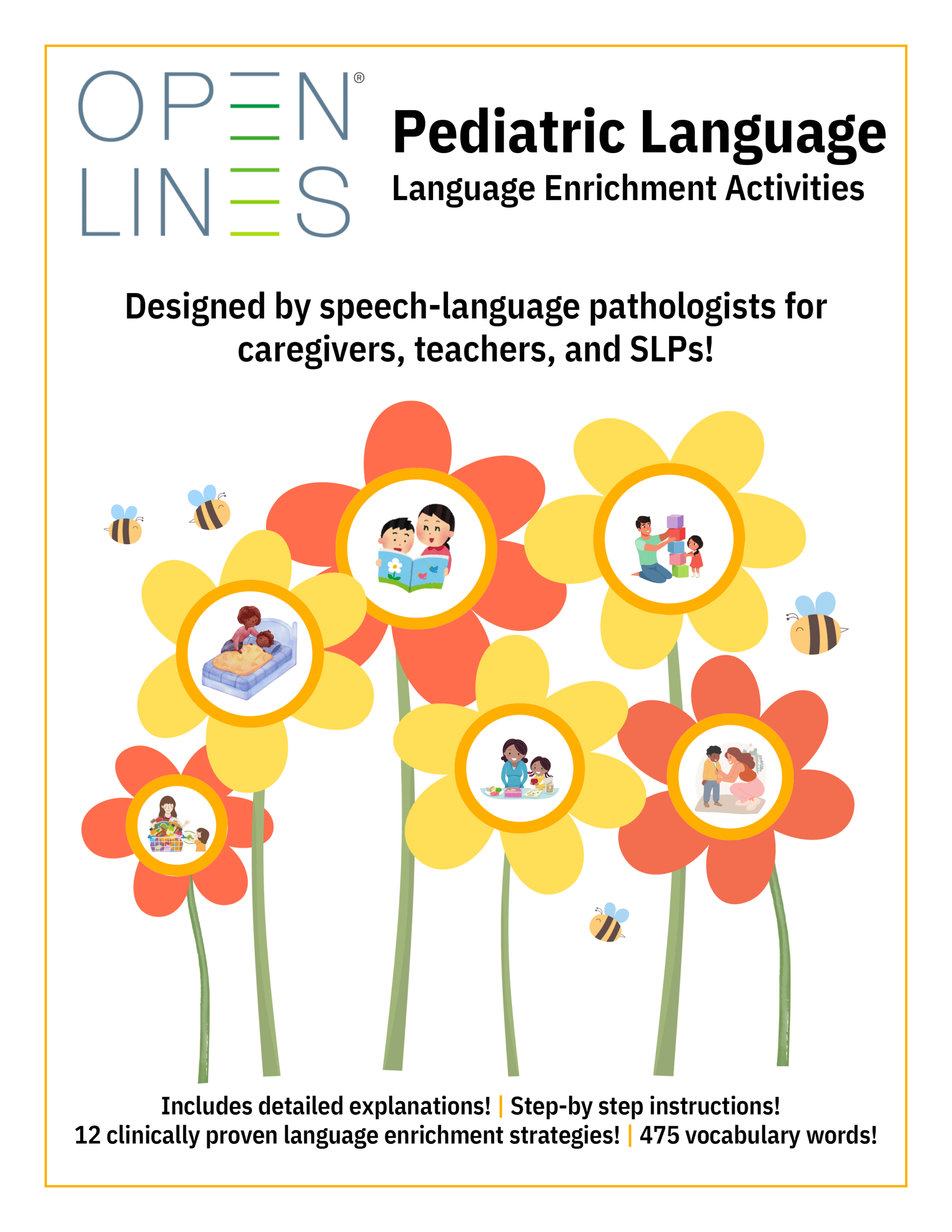
Open Lines Language Enrichment Activities Product
Language Enrichment Activities is a downloadable collection of exercises and resources from Open Lines Speech and Communication designed to help parents and caregivers support their child’s speech and language development at home. It translates evidence-based strategies used by speech-language pathologists in clinical settings into practical, everyday tools — offering detailed descriptions of language-building techniques, real-world conversation examples, and vocabulary recommendations tailored to developmental stages.
The resource centers on a few core ideas: modeling rich vocabulary and varied sentence structures during daily interactions; responding to a child’s communication attempts at their current skill level to build confidence; and weaving language practice into natural moments like playtime, mealtime, and bath time rather than treating it as a separate task. It recommends just 10–15 minutes of focused daily practice, aiming to fit realistically into busy family schedules. The program is designed to be useful for all children, whether they’re developing typically or have identified language delays, and it’s structured to help caregivers feel more confident and skilled in supporting their child’s communication growth.
Learn more here.
Our Language Enrichment Activities product is available for purchase here.
Browse our collection of FREE digital products of speech-language exercises and resources here.
When to Consult With a Speech-Language Pathologist
Parents should consider consulting with a speech-language pathologist when their child demonstrates persistent difficulties with communication milestones or shows signs of speech and language challenges that impact daily functioning. Key indicators include delayed speech development beyond typical age ranges, difficulty being understood by family members or peers, challenges following directions or expressing basic needs, persistent stuttering or voice quality concerns, and difficulty with social communication skills. Additionally, children who have experienced hearing loss, neurological conditions, developmental delays, or traumatic brain injuries may benefit from early speech therapy intervention.
The decision to seek professional evaluation becomes particularly important when communication difficulties interfere with a child’s ability to participate in educational activities, form peer relationships, or express their thoughts and emotions effectively. Early intervention through speech therapy can significantly improve outcomes, as the developing brain demonstrates remarkable plasticity during childhood years. A comprehensive evaluation by a certified speech-language pathologist can identify specific areas of need, rule out underlying conditions, and establish targeted treatment strategies that support the child’s communication development while addressing any associated challenges with feeding, swallowing, or cognitive-communication skills.
If your child is encountering challenges with communication, it’s time to choose Open Lines®. Contact us by calling 212-430-6800, emailing [email protected], or filling out our convenient contact form. Unlock your child’s potential with Open Lines® Speech and Communication today!