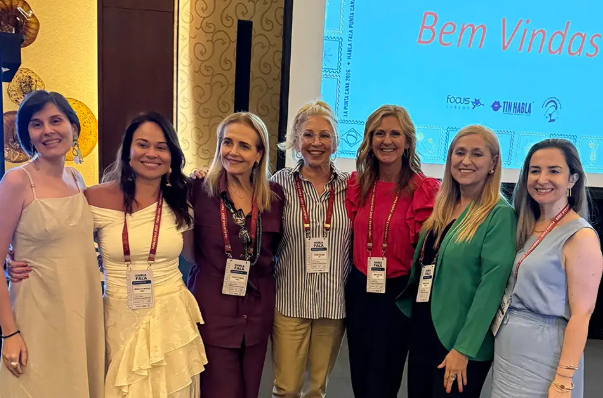
Dr. Jessica Galgano, PhD, CCC-SLP, is the Founder and CEO of Open Lines Speech and Communication and a Faculty Instructor at NYU Grossman School of Medicine. She was recently invited to speak on pediatric motor speech disorders at HablaFala 2026, an international immersion in motor speech disorders held in Punta Cana, Dominican Republic and organized by Focus Cursos. It was an invitation she felt honored to accept, and one that came with an easy decision about what to teach.
Because Open Lines® has seen its most consistent success treating pediatric dysarthria with LSVT LOUD® for KIDS, that protocol was the natural centerpiece for the session. Dr. Galgano was honored to share the podium with Angela Halpern, MS, CCC-SLP, Chief Clinical Officer of LSVT Global, a clinician and researcher whose work has been instrumental in expanding LSVT LOUD to pediatric populations and whose depth of insight brought a rare richness to the material. Dr. Galgano, who serves as an LSVT LOUD faculty member and clinical expert in her own right, has had the privilege of collaborating with Ms. Halpern for years on bringing this work to children who need it, and together they delivered a session titled “Applying Neuroplasticity and Motor Learning Principles to Pediatric Dysarthria: LSVT LOUD for KIDS® as a Model for Evidence-Based Practice.”
Clinicians traveled from across Latin America and beyond to spend three days immersed in the science and practice of motor speech disorders, and the energy in the room reflected that shared commitment.
The Question at the Center of the Talk
Every strong continuing education session starts with a question worth answering, and this one was no exception. How does the field take everything neuroscience has taught us about the brain and turn it into better treatment for children with motor speech disorders? That question set the tone for the entire session, and Dr. Galgano and Ms. Halpern used LSVT LOUD for KIDS as their working answer. From its earliest design, the protocol has taken neuroplasticity seriously, carrying it from the underlying science all the way through to the decisions clinicians make in the treatment room every single day.
Why the Need Is So Large
Before the presenters turned to solutions, they made sure the audience understood the size of the problem. Communication disorders affect at least 50 to 55 percent of children with cerebral palsy, and most individuals with Down syndrome experience significant speech and communication challenges of their own. Dysarthria shows up in children with traumatic brain injury, pediatric stroke, neuromuscular disease, brain tumors, and a range of other neurological conditions, and it can even occur in idiopathic speech delay. Despite how common these challenges are, many children still lack access to treatment options that are both evidence-based and intensive enough to make a real difference.
The presenters grounded that statistic in something more human by sharing research from Boliek and Fox, who interviewed children and parents directly about communication. Three themes ran through those interviews. Children want to be socially accepted, so they almost always choose to try oral communication first. They keep trying to speak even when they are not succeeding. And they often feel deeply frustrated when peers or adults fail to wait long enough to understand them, or worse, speak for them instead. Long before this is a clinical need, Dr. Galgano reminded the room, it is a human one.
Six Principles That Drive Change
At the heart of the session were six principles of activity-dependent neuroplasticity, each one essential to designing treatment for a child with a motor speech disorder.
Specificity matters because the exact type of practice a clinician chooses shapes the exact type of change that follows in the brain. Intensity matters because practice has to be frequent and effortful enough to genuinely challenge the nervous system. Repetition matters because new neural connections need to be practiced again and again before they truly lock in. Complexity matters because tasks have to grow harder as a child improves, rather than staying static. Salience matters because an activity has to feel meaningful and relevant to the child for the brain to change well. And timing matters because developmental and injury-related windows can speed up or slow down how quickly a child adapts.
None of these principles works well on its own. The presenters were clear that the real goal for any clinician is to weave several of them together, in concert, throughout every plan of care.
LSVT LOUD as a Working Model
With those principles established, the session turned to LSVT LOUD itself as a working demonstration of what happens when a protocol is built around them from the start rather than layered on as an afterthought. The target of treatment is vocal loudness, understood broadly as amplitude of movement across the entire speech system. The mode of delivery is intensive and high effort. And the mechanism behind lasting change is calibration, the process of retraining how a child perceives their own voice and the effort it takes to produce speech that is clear and appropriately loud.
Dr. Galgano and Ms. Halpern also explained why voice works so well as a treatment target across many different types of dysarthria, from the reduced loudness seen in hypokinetic patterns like Parkinson’s disease to the breathiness common in flaccid dysarthria associated with Down syndrome. They brought that explanation to life with real acoustic case examples, including a child with cerebral palsy and a young girl with Down syndrome, letting the audience hear the contrast in each child’s speech before and after just one month of treatment.
What the Evidence Shows, and What It Does Not Yet Show
Throughout the talk, the presenters were careful to represent the research honestly rather than overselling it. A 2021 systematic scoping review by Whelan and colleagues found that the highest levels of evidence for treatment-dependent neuroplasticity in motor speech disorders come from a single protocol, LSVT LOUD. At the same time, this remains Phase I and Phase II research. Sample sizes are still small, no randomized controlled trials have been completed yet, and long-term outcome data beyond twelve weeks remains limited. The findings are genuinely exciting, and they are not yet the final word, a distinction the audience seemed to appreciate.
A Case Study in Persistence
One of the most memorable parts of the session was a case Dr. Galgano published together with Grace Tsang and Dr. Lorraine Ramig. The case involved an eighteen-year-old with autism, dysarthria, and childhood apraxia of speech who was not initially considered a candidate for standard LSVT LOUD. Rather than closing the door on him, the treatment team built a novel three-stage pre-treatment protocol that unfolded over eighteen months and gradually developed the skills he needed to eventually complete the full, gold-standard program.
That patience paid off. The client went on to make significant gains in phonation time, speech loudness, and intelligibility, and those gains held steady at a five-month follow-up. For everyone in the room, the case served as a powerful reminder that candidacy criteria describe where a client starts, not where that client has to stay.
Bringing It Back to Monday Morning
The session closed the way every strong continuing education talk should, by bringing the science back into the clinic. Attendees worked through an interactive exercise in which they applied each neuroplasticity principle to one of their own cases, building a mini plan of care that named a specific treatment target, set realistic intensity and repetition parameters, mapped out a complexity progression, and chose functional, salient goals tied to real classroom participation, peer interaction, and self-expression.
The presenters also spent real time discussing the barriers that make intensive treatment difficult to deliver, including school and clinic administration, uneven access to services, family scheduling constraints, and a simple lack of awareness about why intensity matters in the first place. They offered practical solutions for each one, from building intensive treatment blocks into IEPs well in advance, to using telepractice to close access gaps, to reframing intensity for families and administrators as a positive, evidence-based investment rather than an inconvenience.
Gratitude
None of this would have been possible without the people who made HablaFala 2026 happen. Sincere thanks go to Focus Cursos for the invitation and for the opportunity to share this work with such an engaged and generous audience. Michelly and the entire Focus Cursos team deserve particular recognition for the stellar coordination behind every part of the workshop, from logistics to the on-site interpretation that made the session accessible to such an international group of clinicians.
It was also a genuine privilege to spend these days alongside colleagues doing such excellent clinical and research work in this field, including Gaby Sanchez, Elisabeth Campos, and Ana Vogeley. Their contributions to the profession, and to the growth of evidence-based motor speech treatment across Brazil and Latin America, were felt throughout the entire immersion.
Dr. Galgano and Ms. Halpern left Punta Cana energized and already looking ahead to future opportunities to bring this work to Brazil, and they cannot wait to keep growing this collaboration in the near future.
For questions about neuroplasticity, pediatric dysarthria, or LSVT LOUD for KIDS, contact us by calling 212-430-6800, emailing [email protected], or filling out our convenient contact form. Unlock your child’s potential with Open Lines® Speech and Communication today!